Low-cost prosthetic arm
- My role
- Research assistant, Stevens Institute of Technology, summer 2024, under faculty supervision; continued through Avenues’ Mastery Program.
- Year
- 2024
- Type
- Prosthetic arm, research
- Status
- Working build
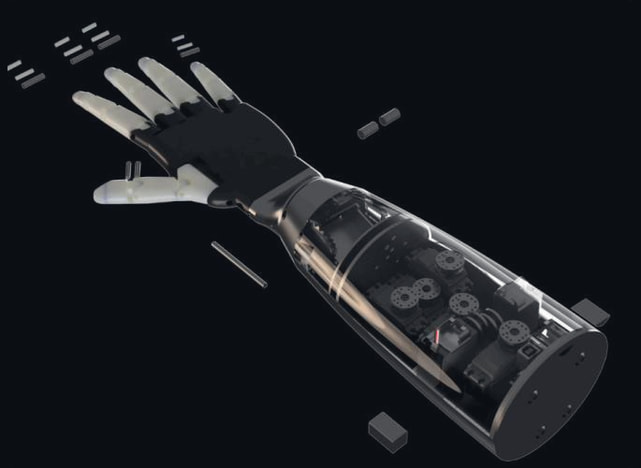
Render of the whole arm: servo stack, gears and board through the translucent forearm.
- 90+ prototypes, from PLA finger test prints to a full printed hand and forearm.
- Servos in the forearm pull Kevlar cords to close each finger; elastic cords open it again.
- Sized to the wearer: the parametric model is built on seven hand measurements.
A 3D-printable lower-arm prosthetic, hand and forearm, built from off-the-shelf parts, driven by servos through tendon-style cords, controlled by a myoelectric sensor, and sized to the wearer from hand measurements.
Results
- prosthetic arm prototypes
- 90+prototypes
- auto-sizing loop ceiling, reporting part mass per cell configuration
- 500iterations
- hand measurements the parametric model is built on
- 7parameters
(Low-cost prosthetic arm)
Versions
Finger prints
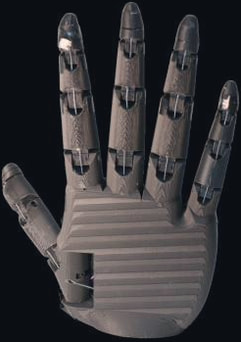
PLA test prints of a finger, then an assembled gray printed hand.
6 printed pieces and 2 pin rods per finger · finger part count
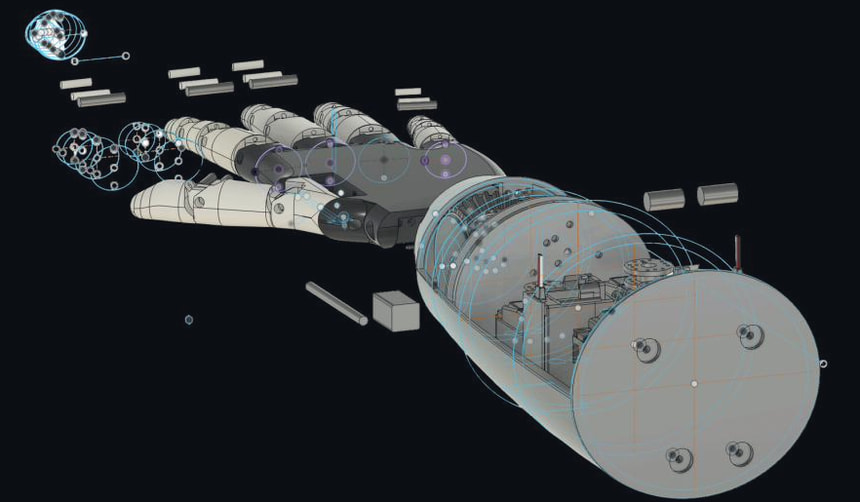
Parametric CAD
Exploded parametric model on seven hand measurements across Digits 1–5.
7 parameters · hand measurements the model is built on
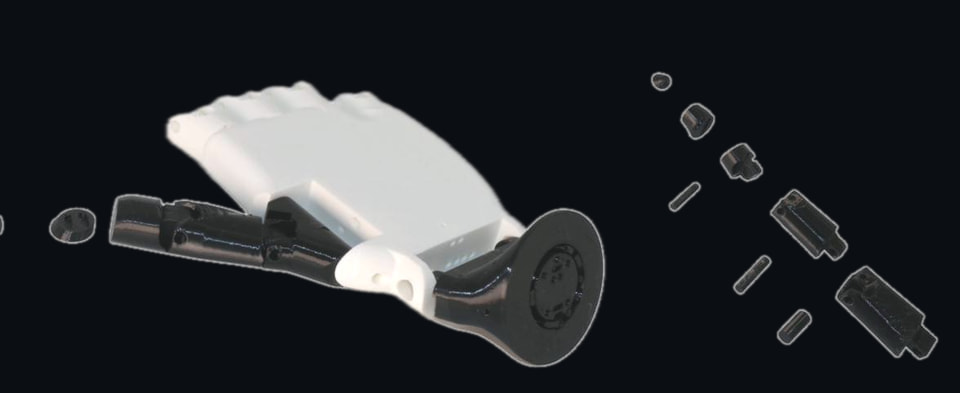
Final build
White palm and glossy black forearm; hand, wrist collar and end plate print as separate segments.
5 forearm subsystems · servos, wrist control, Arduino, batteries, myoelectric control
Gallery
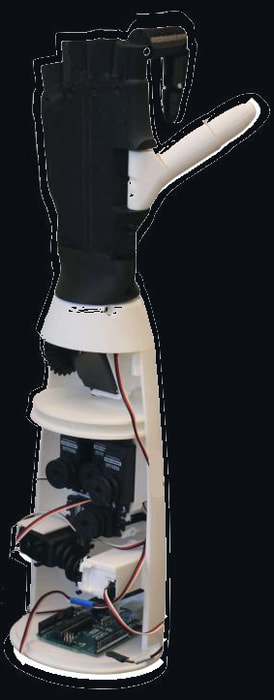
The forearm opened
The forearm opened: servo stack, wiring, Arduino-style board.
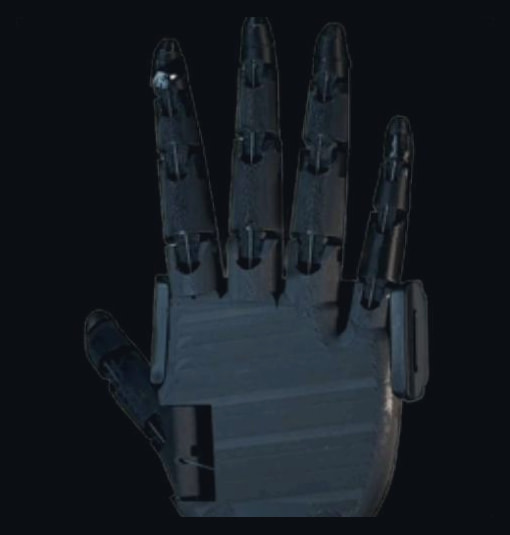
The finished hand
The finished hand from the back, five segmented fingers.
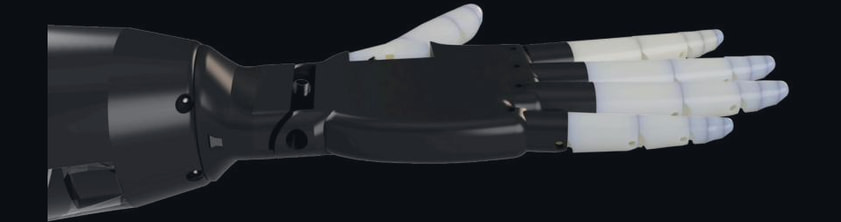
In profile
The finished arm in profile, fingers extended.
- 1
- Hand circumference
- 2
- Hand length
- 3
- Palm length
- 4
- Wrist circumference
- 5
- Finger root circumference
- 6
- Interphalangeal joint circumference
- 7
- Distal interphalangeal joint circumference
The seven hand measurements that size the model, redrawn from the design brief.
How it works
One elastic cord holds the finger open; a Kevlar cord from a servo in the forearm pulls it closed. Elastic runs outside the bend, Kevlar inside.
The joint angles in this drawing are illustrative: they are chosen so the hand closes at full travel, not measured from the build.
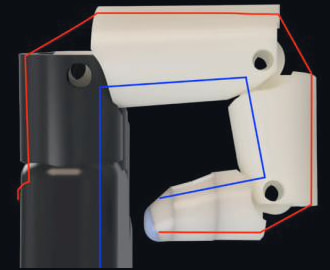
From the design brief: elastic (red) and Kevlar (blue) paths.
Facts
- My role
- Research assistant, Stevens Institute of Technology, summer 2024, under faculty supervision; continued through Avenues’ Mastery Program.
- When
- Summer 2024, then continued.
- With
- Stevens Institute of Technology, faculty-supervised.
- Status
- Working build. Controls and size automation are still being refined.
- Stack
- Off-the-shelf parts, mostly 3D-printed; servos; elastic and Kevlar cord; EMG sensor; Arduino.
- Awards
- None.
- Prototypes
- 90+.